ADHD Horror Stories in Three Words: What more than 300 Answers Reveal About Everyday Life.
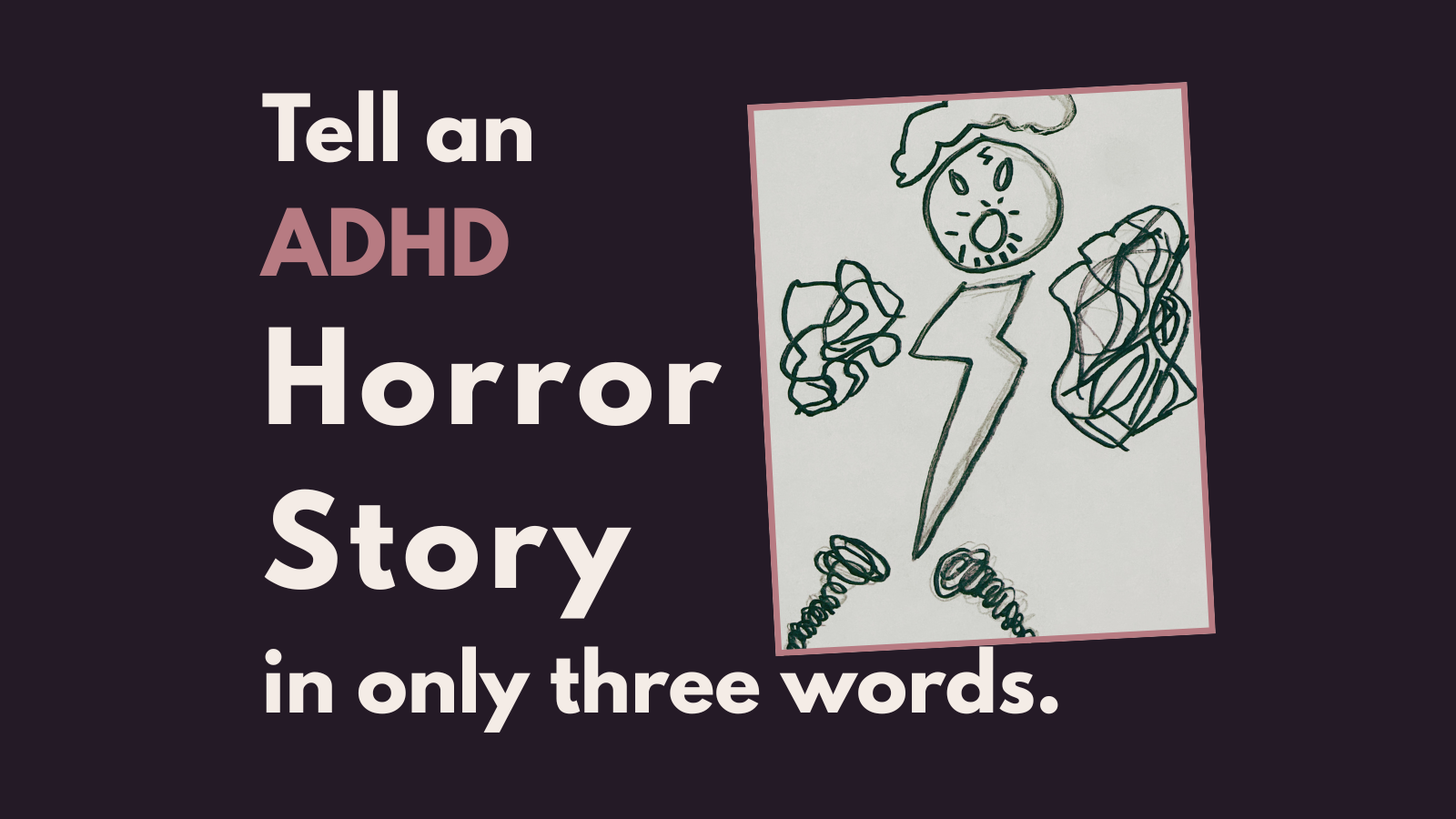
Artwork by my son.
Ask an ADHD group to describe an ADHD horror story in three words, and nobody mentions monsters. No haunted houses. No dark basements. Not one creepy doll.
Instead, they say:
Appointment at three.
Free trial confirmed.
Company is coming.
Online booking unavailable.
That last one may be the scariest to me because now I have to make an appointment and a phone call.
I came across this question in an ADHD group for women, and by the time I saw it, more than 300 people had answered. I started taking screenshots because the responses were so good.
Not comedian funny. The other kind of funny. The kind where you laugh because someone writes “Appointment later today” and suddenly a whole group of women understands why absolutely nothing else is getting done that day. That is the strange thing about ADHD humor: we’re very good at making something funny while it is actively making our lives harder.
As I read through them, I started noticing the same themes over and over. Apparently, many of us are being haunted by the same handful of completely ordinary things.
Time. Keys. Laundry. Phone calls. Free trials. Other people chewing.
None of these sounds like a crisis until you have an ADHD brain and one of them quietly takes down your entire afternoon. So here’s a small tour through the horror stories, plus something that has worked for me. Not a new system to maintain. Just hopefully a little less friction the next time around.
A note: this was inspired by a comment thread, not a scientific study.
Responses are shared anonymously.
“Appointment at Three” Apparently My Day Is Now Booked.
Why does a 3:00 appointment somehow begin the moment I wake up?
I don’t want to start anything substantial because I have to leave later. I don’t want to get too comfortable because I need to remember the appointment. But I also don’t start getting ready because 3:00 is still hours away.
So I spend the morning doing nothing particularly useful while thinking about the appointment.
Then 2:17 appears out of nowhere.
This is the part that makes no sense to people who don’t experience it. How can one appointment take up an entire day and I still end up rushing? I have been mentally attending it since breakfast.
The comments included every version of this:
Appointment later today.
Be on time.
Sorry, I’m late.
No alarm set.
You’re late again.
There were also people who spent the entire day preparing for an appointment, arrived and discovered it was actually tomorrow. Which would be funny if they had not already donated the whole day to it. (been there…done that!)
Knowing what time it is and accurately feeling how long something will take are not the same skill. That gap isn't a character flaw; it's just how ADHD time perception tends to work.
What Helps (at least a little)
What helps me most is putting the leaving time on the calendar, not just the appointment time. “Appointment at 3:00” still leaves me to do several rounds of very optimistic math. “Shoes on at 2:10; leave at 2:20” tells me what to do.
I also need alarms with actual instructions. An alarm labeled leave now works better than a random noise I will silence while wondering why I set it.
On appointment days, I pull a few tiny, safe things from my brain-dump list. Empty the dishwasher. Answer one email. Fold ten things. Nothing involving paint, power tools or reorganizing a closet. I know myself.
“Where Are My Keys?” A Daily Limited Series With Unlimited Episodes
Then came all the things we lose, forget or leave somewhere “safe.”
Where are my…?
Where’d I park?
Forgot my wallet.
Left at home.
I forgot something.
Thought I did.
Thought I did may be my favorite because it covers so much territory.
Did I reply to that message, or did I think about replying so thoroughly that my brain filed it as completed? Did I turn off the burner? Did I send the form? Did I move the laundry, or did I only say, “I need to move the laundry” as I walked past it?
Ooh, this is a good one - the special hiding place. The place where we put an important item because this time we are going to be responsible and keep it safe.
No one will ever find it again.
The frustrating part is that forgetting gets interpreted as not caring. If you cared, you would remember. If it mattered, you wouldn’t lose it.
But I can care very much and still have no idea where I put the thing that I was holding four minutes ago. Both can be true.
What Helps (at least a little)
Important things need homes where they naturally land, not homes that make sense in an imaginary, highly organized version of my life.
If the keys always land near the door, the key hook needs to be near the door. If medication is forgotten inside a pretty cabinet, maybe it needs to be somewhere visible. If I need a pen in three different rooms, perhaps owning three pens with a pen leash attached in each room is better than repeatedly going on a household scavenger hunt.
I am also trying to capture things immediately. A voice reminder, one running note or a quick photo has a much better success rate than, “I will definitely remember this later.”
I will not definitely remember it later.
“Couldn’t Get Started.” But I Did Line a Drawer.
This one is painfully familiar.
Couldn’t get started.
Daily task paralysis.
I can’t move.
Make a decision.
Making a call.
Just do it.
I have things I genuinely want to do. Things I am excited about. Things I have chosen for myself. I can think about doing them, talk about doing them and get angry with myself for not doing them.
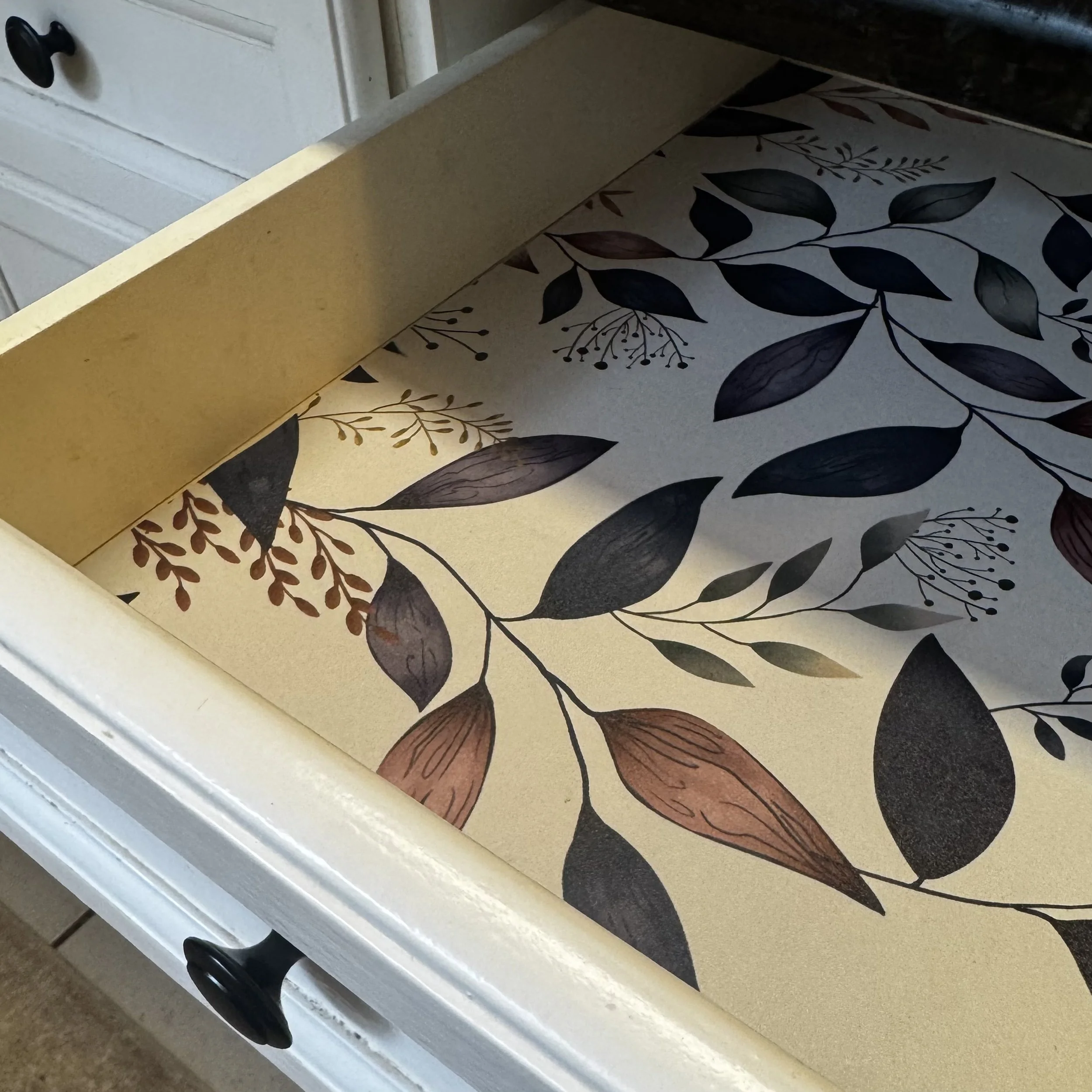
Then I look up and I am lining a drawer with contact paper. (It looks great, thanks for asking!)
The drawer did not ask for help. The drawer was fine. But apparently the drawer felt more startable than the thing I actually cared about.
That is the part people miss when they call it laziness or procrastination. I am not relaxing while I avoid the task. The task is humming in the background the entire time, and I am usually annoyed with myself while doing something much less important.
Knowing exactly what needs to be done does not always create the ability to begin doing it.
What Helps (at least a little)
I have found that the best starting point is usually smaller than I think it should be.
Not write the article. Open the document and write one bad sentence.
Not clean the kitchen. Put away 5 things.
Not make the appointment. Write down the name and phone number of who to call.
The first move should be physical and almost absurdly small.
“Then, the Phone Rang.” And the Entire Thought Disappeared.
Another theme was the strange way attention can go in completely opposite directions.
Too many tabs.
Bloody rabbit hole.
Then, phone rang.
I’ll finish later.
Interrupted hyperfocus.
Sometimes I cannot stay with one thing for more than three minutes because every new sound, thought or notification pulls me somewhere else.
Other times I am so focused that interrupting me feels like someone shut off the lights in a room I had finally found my way into.
I begin one simple task that requires a password, so I open my email. There is a shipping notification in my inbox, which reminds me that I need to return something. I search for the return policy and somehow end up looking at packing cubes for a trip I am not currently planning.
Twenty-two minutes later, the original task is still open somewhere under seventeen tabs.
I wish I could say that example was wildly exaggerated.
What Helps (at least a little)
When I have to stop in the middle of something, leaving myself one sentence helps: I was doing this, and the next step is this. Otherwise I come back and have to reconstruct the entire thought from the beginning.
I also need somewhere to put the sudden things I want to research. One running “look this up later” note gives the thought somewhere to go besides a brand-new browser tab.
And sometimes I need to protect fifteen minutes. Phone facedown. Notifications off. Unrelated tabs closed. Not a perfect two-hour focus block. Just fifteen minutes in which nothing new gets to pull me somewhere else.
“The Pile Grew.” So Rude!
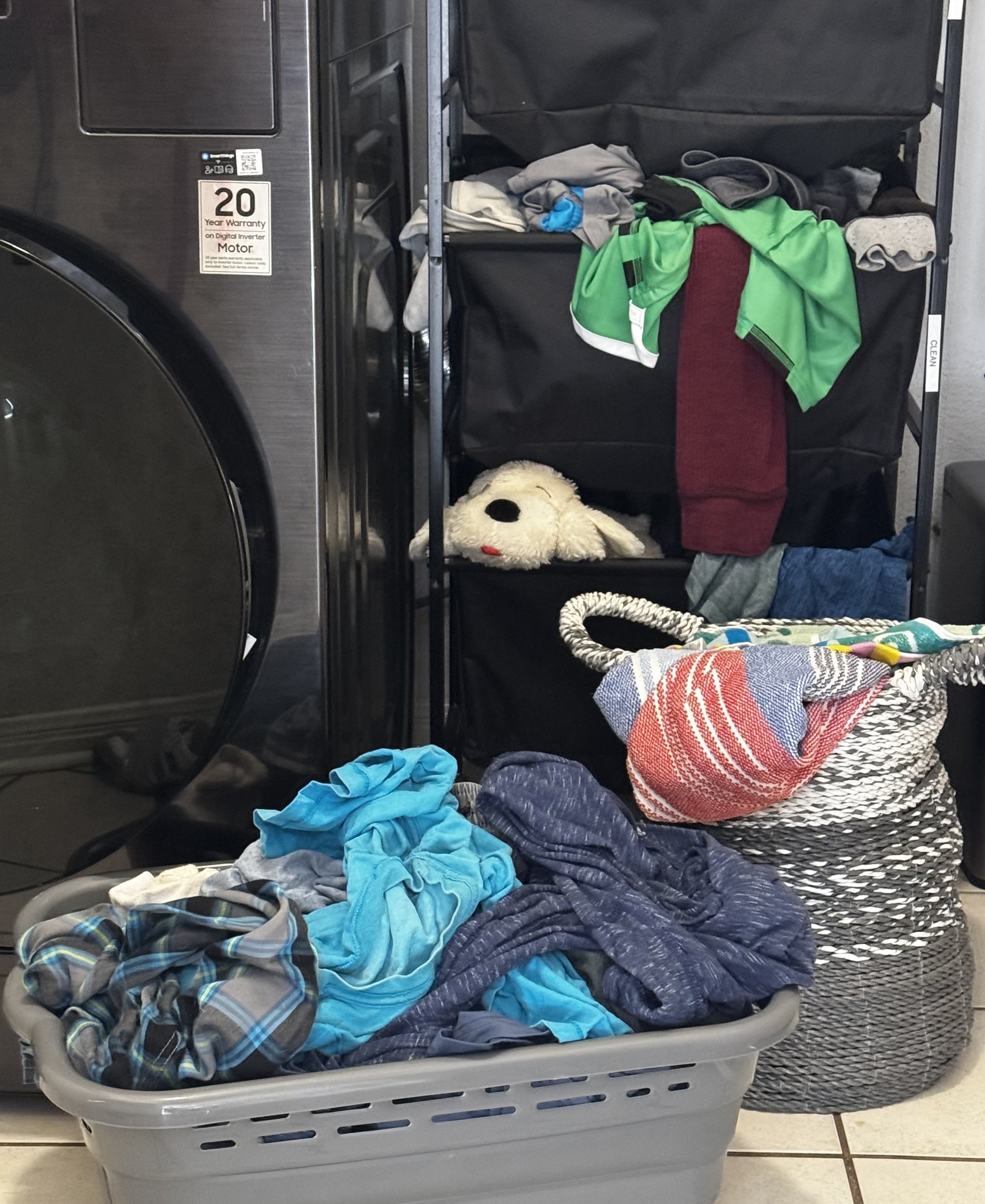
I did not make a conscious decision to stop doing laundry.
I simply did not do it one day. Then there was another day. And suddenly it was no longer laundry. It was a situation.
The household answers were their own category:
The pile grew.
Can’t clean house.
Laundry, dishes, mopping.
Total organized chaos.
Company is coming.
Nothing creates emergency focus quite like learning that another person is about to enter your home.
Suddenly, three weeks of postponed decisions are being made in forty-seven minutes. Things get swept into bags. The bags get shoved into closets. Doors get closed. A candle is lit as though a pleasant smell will clear us of all charges.
The hard part about housework is that it never actually stays done. It is repetitive, not very interesting and full of tiny decisions. Even putting away one object can turn into: Where should this live? Is there room there? What do I do with the things already in that spot? Why do we own seven of these?
The pile is not one job. It is all the little decisions I did not have the energy to make the first time.
What Helps (at least a little)
This is where I strongly believe our homes need to be designed for the people who actually live in them.
If everyone drops shoes in one spot, that spot needs a basket. If clothes collect on a chair, maybe the hamper belongs beside the chair instead of in the place where hampers are “supposed” to go. If someone needs to see an item to remember it exists, attractive open storage may work better than hiding everything behind a cabinet door.
I love a beautiful home. But a beautiful system that no one in the family uses is just decor.
I also get more relief from clearing one surface I look at constantly than from half-cleaning five rooms. And a ten-minute closing shift for dishes, trash and obvious clutter can keep tomorrow’s mess from feeling completely impossible. This is very much a work in progress at my house.
Ten minutes. Not “until the whole house is done,” because we would all die here.
“Wet Bath Mat.” I Cannot Explain Why This Is the Final Straw.
Some of the horror stories had nothing to do with forgetting or being late.
They were simply about existing in a world with sounds, crowds and damp fabric.
Someone’s tapping a pen
Wet bath mat.
Small, crowded room.
Too many people.
Many verbal instructions.
Slow people walking.
Sensory overwhelm is not something every person with ADHD experiences, but enough women immediately understood these answers that they clearly belonged in the thread.
Sometimes I can handle ten legitimate problems and then one small thing - a noise, an itchy tag, someone walking too slow - becomes the thing that takes me out.
From the outside, the reaction may look wildly out of proportion. From the inside, that one small thing was simply the last thing added to a system that was already full.
What Helps (at least a little)
The answer is often ridiculously basic: earplugs, softer lighting, clothes that do not bother me, leaving the gathering for five quiet minutes.
The difficult part is letting myself use those things before I am completely overwhelmed. I do not need to wait until I am about to snap before I am allowed to make the environment easier.
“Free Trial Confirmed.” We All Know How This Ends.
A free trial is not free when its entire business model depends on me remembering one specific date in the future.
The financial answers were brief but complete:

Free first month.
Free trial confirmed.
Rent is due.
Found my bills.
Pay bills now.
Then there are the returns that live in the car until the return window closes. The groceries purchased with excellent intentions. The replacement item bought two days before the original turns up. The late fee on a bill we had enough money to pay.
People call this the ADHD tax. It can be funny in the retelling, but it is not imaginary money. It adds up. So does the shame of knowing it was avoidable and still not avoiding it.
What Helps (at least a little)
If a service lets me cancel a trial immediately and keep using it until the end date, I need to cancel it while I am still on the confirmation screen. I cannot hand that job to Future Tracy. She has enough going on.
Autopay and alerts help when the account balance makes that safe. Returns need to sit by the door or directly in the car, not be responsibly tucked away where I will stop seeing them.
And when the ADHD tax still happens, because sometimes it will, adding an emotional late fee does not get the money back. The late fee was real. The shame tax is optional.
The Relief of Being Recognized
After reading all of those responses, I did not think, Oh good, none of this matters.
It does matter. These things cost time, money, energy and peace. They can frustrate the people we live with. They can make us feel unreliable. They can turn a perfectly ordinary Tuesday into something that requires recovery time.
But there was relief in seeing how many people understood each other in three words.
Most of the responses made me laugh. Then I reached one that changed the feeling of the whole thread:
Not meeting potential.
That one didn’t feel like a funny inconvenience. It felt like the story underneath all the other stories.
That deserves its own conversation. That’s next.
This article is for education and shared recognition, not diagnosis or medical advice. Not every experience described here is exclusive to ADHD. If attention, impulsivity or executive-function difficulties are interfering with your life, consider talking with a qualified healthcare professional.